

Stage 1 breast cancer is a small tumour of up to 2 cm with no distant spread. We explain which symptoms should raise concern, how the diagnosis is confirmed, which operations and therapies are used, and why the outlook at this stage is the most favourable.
What stage 1 breast cancer means
Stage 1 is early invasive cancer: the tumour is no larger than 2 cm (T1), the lymph nodes are clear or contain only micrometastases, and there are no distant metastases (M0). Treatment is most effective at this stage, and in most cases the breast can be preserved. Breast cancer is the most common cancer in women: according to the WHO, more than 2 million new cases are diagnosed worldwide every year.
Risk factors
- age over 40–50;
- breast or ovarian cancer in close relatives, BRCA1 and BRCA2 gene mutations — with such a history genetic testing is worth considering;
- early first period (before 12) and late menopause (after 55);
- no childbirth or a first birth after 30;
- long-term hormone replacement therapy in menopause;
- excess weight after menopause, a sedentary lifestyle;
- regular alcohol use, smoking;
- radiotherapy to the chest at a young age.
Symptoms
At stage 1 the disease often causes no sensations at all, and the tumour is found on a screening mammogram. Warning signs include:
- a firm lump in the breast or armpit;
- a change in the shape or size of one breast;
- nipple retraction or discharge, especially bloody;
- redness, dimpling or an orange-peel look of the skin;
- crusting or scaling around the areola.
Most breast lumps turn out to be benign — a fibroadenoma, a cyst or fibrocystic changes — but only an examination can tell them apart from cancer.

Diagnosis
- mammography, with tomosynthesis if needed;
- ultrasound of the breasts and regional lymph nodes;
- breast MRI — for dense tissue, BRCA mutations or surgical planning;
- core needle biopsy — the only way to confirm the diagnosis;
- immunohistochemistry: oestrogen and progesterone receptors, HER2, Ki-67 index.
The results define the biological subtype — luminal A, luminal B, HER2-positive or triple-negative. The subtype determines whether hormone therapy, chemotherapy or anti-HER2 drugs are needed. For hormone-receptor-positive tumours, genomic tests (Oncotype DX, MammaPrint) help decide whether chemotherapy can be safely omitted.
Treatment of stage 1 breast cancer
Surgery
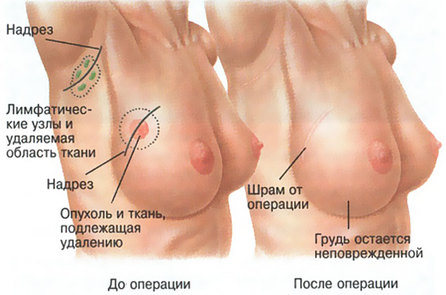
The standard at stage 1 is breast-conserving surgery (lumpectomy): the tumour is removed with a small margin of healthy tissue. A sentinel lymph node biopsy is performed at the same time to check whether tumour cells have spread. Mastectomy is offered when there are several lesions, a BRCA mutation, or by the patient's choice; the breast can be reconstructed during the same operation by plastic surgeons.
Radiotherapy
After breast-conserving surgery the breast is irradiated to lower the risk of recurrence. Modern shortened schedules take from one to three or four weeks.
Drug therapy
- Hormone therapy (tamoxifen or aromatase inhibitors) for 5–10 years — for hormone-receptor-positive tumours.
- Chemotherapy — for triple-negative and HER2-positive cancer, sometimes before surgery.
- Targeted therapy (trastuzumab) — for the HER2-positive subtype.
- Bisphosphonates — for postmenopausal women, to protect the bones and lower the risk of bone metastases.
Prognosis
According to the SEER registry, the five-year relative survival rate for localised breast cancer is above 95%. After treatment, women have regular check-ups and a yearly mammogram. Physical activity, a healthy weight and avoiding alcohol reduce the risk of the disease coming back.
How to detect cancer in time
The most reliable method is screening mammography: most programmes recommend it every one to two years from the age of 40–50, and earlier, combined with MRI, for women at high hereditary risk. Self-examination does not replace mammography, but it helps to notice changes between doctor's visits.
Frequently asked questions
Is chemotherapy always needed?
No. For small hormone-receptor-positive tumours with a low genomic risk score, surgery, radiotherapy and hormone therapy are enough.
Can the breast be preserved?
In most cases, yes: at stage 1, breast-conserving surgery with radiotherapy gives the same results as mastectomy.
Where to treat breast cancer abroad?
Certified breast centres operate in Germany, Turkey, Israel, Spain and South Korea — see clinics in the oncology section.
Still have questions? Send a request — Clinics Direct medical coordinators will help you choose a clinic and specialist and find out the cost of treatment, free of charge.
