
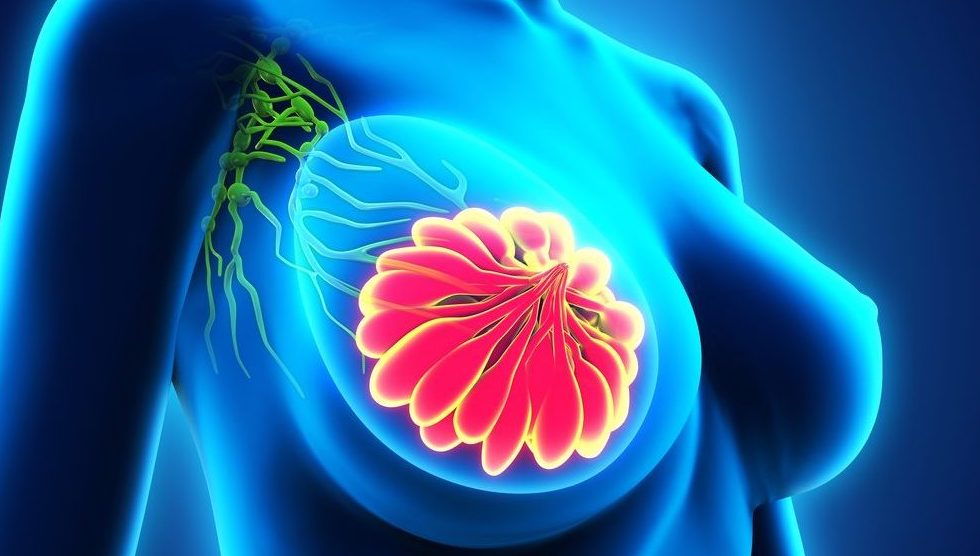
HER2-positive breast cancer: what the diagnosis means, how it is confirmed, how it is treated at early stages and when it has spread, the outlook and new drugs. We explain targeted therapy, antibody-drug conjugates and a study by Spanish oncologists.
What is HER2-positive breast cancer
HER2 is a receptor protein on the cell surface that tells cells to divide. In about 15–20% of breast cancers the tumour cells carry too much of this protein, and the cancer is called HER2-positive. Untreated, it grows faster than other subtypes, but it is also the subtype for which the most effective targeted drugs have been developed, so today its treatment results are among the best.
How HER2 status is determined
The status is assessed on a tumour sample taken at biopsy:
- immunohistochemistry (IHC) — a score from 0 to 3+. A score of 3+ means HER2-positive cancer; 0 and 1+ mean negative;
- FISH or another in situ hybridisation test — done when the result is an equivocal 2+, to check whether the HER2 gene is amplified.
HER2-low cancer is a separate group: IHC 1+, or 2+ with a negative FISH. Effective drugs have appeared for it too. Oestrogen and progesterone receptors and the Ki-67 index are tested together with HER2, and the treatment plan depends on the whole set.
Treatment of early HER2-positive breast cancer
- Drug treatment before surgery. For tumours larger than 2 cm or with lymph node involvement, treatment starts with chemotherapy plus trastuzumab and pertuzumab. In a considerable share of patients the tumour disappears completely before surgery.
- Surgery — breast-conserving surgery or mastectomy, with reconstruction if needed.
- Treatment after surgery. Anti-HER2 therapy continues for up to a year. If tumour cells remain in the removed tissue after preoperative treatment, trastuzumab is replaced with trastuzumab emtansine (T-DM1).
- Radiotherapy and hormone therapy — when indicated, if the tumour is hormone-sensitive.
For small tumours without lymph node involvement the regimen is lighter: surgery first, then a short course of chemotherapy with trastuzumab. Read about early-stage treatment in the article Stage 1 breast cancer.
Treatment of metastatic HER2-positive breast cancer
- First line — trastuzumab and pertuzumab with a taxane.
- Second line — trastuzumab deruxtecan, an antibody-drug conjugate.
- Brain metastases — tucatinib with trastuzumab and capecitabine, radiosurgery.
- Later lines — T-DM1, lapatinib, neratinib and other combinations.
Anti-HER2 drugs can affect the heart, so echocardiography is repeated regularly during treatment; with trastuzumab deruxtecan the lungs are monitored.
New drugs: antibody-drug conjugates
A conjugate is two drugs in one: the antibody finds a cell carrying the HER2 receptor and delivers a cytotoxic agent inside it. The chemotherapy acts in the tumour and does less damage to healthy tissue.
One of these agents is trastuzumab duocarmazine. The results of its first clinical trial were published in The Lancet Oncology in 2019; a co-author was Dr Valentina Boni, an oncologist at the START phase I clinical trials unit of the Clara Campal Comprehensive Cancer Centre of the HM Hospitales group. The trial ran for four years in Spain, Belgium, the Netherlands and the United Kingdom and included about 200 patients with advanced breast, gastric, endometrial and urothelial tumours. The drug was effective in about a third of patients with HER2-positive breast cancer resistant to previous treatment.
“These are ‘smart’ drugs that direct chemotherapy into the tumour cells, using the antibody as a Trojan horse. This increases efficacy and reduces the classic side effects of chemotherapy,” explains Dr Boni.
The drug was later studied in a phase III trial. It has not yet been registered for general use, and another conjugate — trastuzumab deruxtecan — has become the second-line standard. Access to new drugs is possible through clinical trials run by large cancer centres.
Prognosis
With modern treatment, more than 90% of patients with early HER2-positive breast cancer live five years or longer, and most of them are cured. In metastatic disease, median survival with first-line therapy is about five years, and some patients live considerably longer. These are averages: the outlook depends on the stage, the response to treatment and the hormone receptor status of the tumour.
Frequently asked questions
Is HER2-positive breast cancer good or bad news?
The tumour is more aggressive, but it has targeted drugs that other subtypes lack. With the right treatment the outlook is good.
How long does trastuzumab treatment last?
In early cancer — one year, with an infusion or injection every three weeks. In metastatic cancer — for as long as it keeps the disease under control.
Should HER2 status be retested?
Yes, if the result is equivocal or the disease has returned: the status of metastases can differ from the primary tumour. Clinics abroad review existing slides and blocks.
Where is HER2-positive breast cancer treated abroad?
In cancer centres in Spain, Germany, Israel and Turkey — see clinics in the oncology section.
Still have questions? Send a request — Clinics Direct coordinators will help you choose a clinic and oncologist, arrange a pathology review and find out the cost of treatment, free of charge.
