
When the hip joint is destroyed by grade 3–4 arthritis or injury, joint replacement restores pain-free movement. This article covers the indications, implant types and fixation, the surgery itself, risks and recovery.
When hip replacement is needed
Hip replacement is recommended when pain and stiffness interfere with daily life and medicines, physiotherapy and injections no longer help. The main indications are:
- grade 3–4 osteoarthritis of the hip;
- femoral neck fracture, especially in older people, and non-union after it;
- avascular necrosis of the femoral head;
- hip dysplasia;
- rheumatoid arthritis, ankylosing spondylitis;
- tumours of the femoral head.
Surgery is postponed in case of active infection or decompensated heart, lung or kidney disease. Obesity and diabetes do not rule out the operation, but they raise the risk of complications and call for preparation.
Types of implants
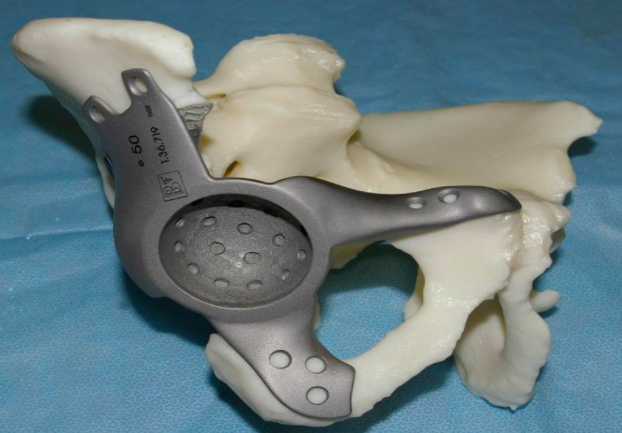
A standard implant consists of a stem placed in the femur, a head, a cup in the pelvic bone and a liner between them. The head and liner form the bearing surface:
- ceramic or metal on polyethylene — the most common option; modern cross-linked polyethylene wears very slowly;
- ceramic on ceramic — the highest wear resistance, often chosen for young active patients;
- metal on metal — now rarely used because of metal particle release.
According to national joint registries, most modern implants last 15–25 years or longer; a worn implant is replaced during revision surgery.
Implant fixation
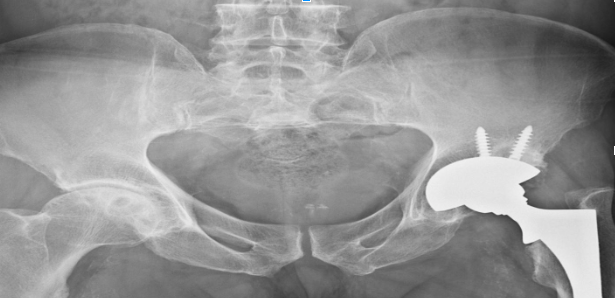
- Cementless (press-fit). An implant with a porous surface is fitted tightly into the bone, which grows into it over time. Suitable for patients with strong bone.
- Cemented. The implant is fixed with bone cement. Used mainly in older patients and in osteoporosis.
- Hybrid. One component (usually the stem) is cemented and the other is not.
The surgeon chooses the fixation based on age, bone quality and activity level.
Types of surgery
- Total hip replacement — both the femoral head and the socket are replaced. This is the standard for arthritis.
- Hemiarthroplasty — only the head is replaced; mostly performed in older patients with a femoral neck fracture.
- Resurfacing — the head is not removed but capped with a metal cover; used rarely, in selected young patients.
How the surgery is done
Preparation includes an X-ray or MRI, blood tests, an ECG, an anaesthetist's consultation and implant planning based on the images. The operation takes 1–2 hours under spinal or general anaesthesia. Many clinics use minimally invasive approaches in which the muscles are moved aside rather than cut, which speeds up recovery.
Recovery and risks
Patients stand and walk with support on the day of surgery or the next day. The hospital stay is 3–7 days, crutches are needed for 4–6 weeks, and most people return to normal activity within 2–3 months. The result depends greatly on rehabilitation.
Possible complications are infection, blood clots, dislocation and leg length difference. Antibiotic prophylaxis, blood thinners, early mobilisation and the surgeon's experience reduce their likelihood.
Why patients choose treatment abroad
Specialised orthopaedic centres perform hundreds or thousands of these operations a year, use implants from leading manufacturers and start rehabilitation right after surgery. Clinics Direct patients most often choose clinics in the Czech Republic, Lithuania, Turkey, Spain and Germany — compare them in the orthopaedics and traumatology section.
Frequently asked questions
How long does a hip implant last?
For most patients, 15–25 years or longer. It depends on the bearing surface, body weight and activity.
When can I fly home?
Usually 7–14 days after surgery, once the doctor is satisfied that the wound is healing and the risk of clots is under control.
Can both hips be replaced at once?
Sometimes, but more often the operations are done a few weeks or months apart — the surgeon decides.
Want to know the cost of hip replacement in different countries? Send a request — Clinics Direct coordinators will forward your images to surgeons and obtain treatment plans with prices, free of charge.
