
More than a million new cases of prostate cancer are registered worldwide every year. In many countries it is the second or third most commonly diagnosed cancer in men. This article explains in more detail how prostate cancer is diagnosed and treated.
Anatomy of the prostate
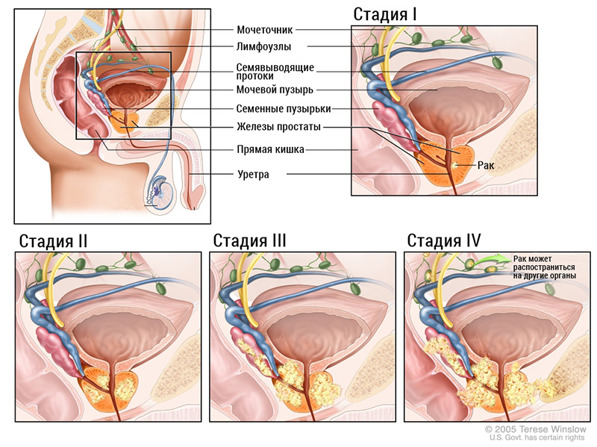
The prostate gland is an unpaired organ of the male reproductive system. It produces the liquid part of semen (prostatic fluid) and closes the outlet of the bladder during an erection. Prostatic fluid contains enzymes, immunoglobulins, vitamins, zinc ions and citric acid. The gland lies below the bladder and surrounds the urethra where it leaves the bladder.
Structure of the prostate
In an adult man the gland has a volume of about 25 cubic centimetres on average. It is built on smooth muscle tissue, and glandular cells appear in it during puberty. The organ consists of glandular acini, fibromuscular stroma, the prostatic utricle, the ducts of the prostatic glands and the openings of the ejaculatory ducts. The central part of the gland is divided by a groove. The prostate lies close to the rectum.
Causes of prostate cancer
The true cause of the disease is still poorly understood, because prostate cancer develops through a combination of many factors. The main risk factor is age: about 70% of cases are diagnosed in men over 65. Men with a family history of the disease are also at risk. Other predisposing factors include:
Too much fat in the diet.
Smoking.
Alcohol abuse.
Progressive prostate adenoma.
Chronic vitamin D deficiency.
Previous testosterone therapy.
Signs of prostate cancer
At an early stage the malignant process causes no symptoms. As the tumour grows, patients notice signs similar to those of prostate adenoma or inflammation of the gland (prostatitis). The symptoms that usually make men see a doctor are:
Pain and burning in the perineum during ejaculation or urination.
Blood in the urine and semen.
A dragging pain above the pubic bone and in the lower back.
Erectile dysfunction.
In the late stages these are joined by swelling of the legs, physical exhaustion and anaemia.
Grades and stages of prostate cancer
The Gleason score is used to assess how aggressive the tumour is:
2 to 6 points: a slow-growing tumour with low aggressiveness.
7 points: a moderately differentiated tumour with moderate aggressiveness.
8 to 10 points: a poorly differentiated tumour that grows quickly and has a high potential to spread.
The TNM classification distinguishes the following stages:
T1: the tumour is small, cannot be felt on examination and does not affect general well-being.
T2: the tumour is larger but stays within the capsule of the gland.
T3: the tumour grows through the capsule and may involve the seminal vesicles.
T4: the tumour spreads beyond the gland to the pelvic wall, rectum, sphincter or bladder neck.
N1: there are metastases in the regional lymph nodes.
M1: distant metastases are found in other organs, bones and lymph nodes.
Treatment of prostate cancer
Prostate cancer is treated, with curative or palliative intent, by surgery and by non-surgical therapy.
Surgery
The main treatment is radical prostatectomy: complete removal of the gland, the prostatic part of the urethra, the seminal vesicles and the bladder neck. After a conventional open operation patients quite often develop erectile dysfunction and urinary incontinence. Clinics abroad now perform robot-assisted and laparoscopic prostatectomy, which helps to reduce these risks.
Chemotherapy
Chemotherapy is given after surgery or as palliative care when the tumour cannot be operated on. The drugs used for prostate cancer are cabazitaxel and docetaxel.
Radiotherapy
Patients with prostate cancer receive external beam radiotherapy, combined radiotherapy, brachytherapy and palliative radiotherapy. Stereotactic radiosurgery, which delivers a concentrated beam of ionising radiation to the tumour, is also used.
Medication
Drug therapy is mainly symptomatic: its aim is to relieve pain and make urination easier. Painkillers and antispasmodics are prescribed for this purpose.
Hormone therapy
Tumour growth can be slowed by suppressing testosterone production. LHRH agonists (triptorelin, buserelin, goserelin) are used for this. Less often, gonadotropin-releasing hormone antagonists (degarelix) and antiandrogens (flutamide, nilutamide, bicalutamide) are prescribed.
Immunotherapy
In some countries sipuleucel-T, which has passed clinical trials, is used for immunotherapy of prostate cancer. Whether this method suits a particular patient is decided by the oncologist.
Outlook
At stages T1 and T2 without spread to the lymph nodes, radical removal of the gland gives a five-year survival rate of about 80% and a ten-year survival rate of 65-70%. The outlook is less favourable for men with poorly differentiated and metastatic cancer. Prevention consists of regular visits to a urologist and timely treatment of diseases of the genitourinary system.
Still have questions? You can call us or leave a request on our website, and experienced medical coordinators will answer your questions about specialists, clinics and treatment prices.