
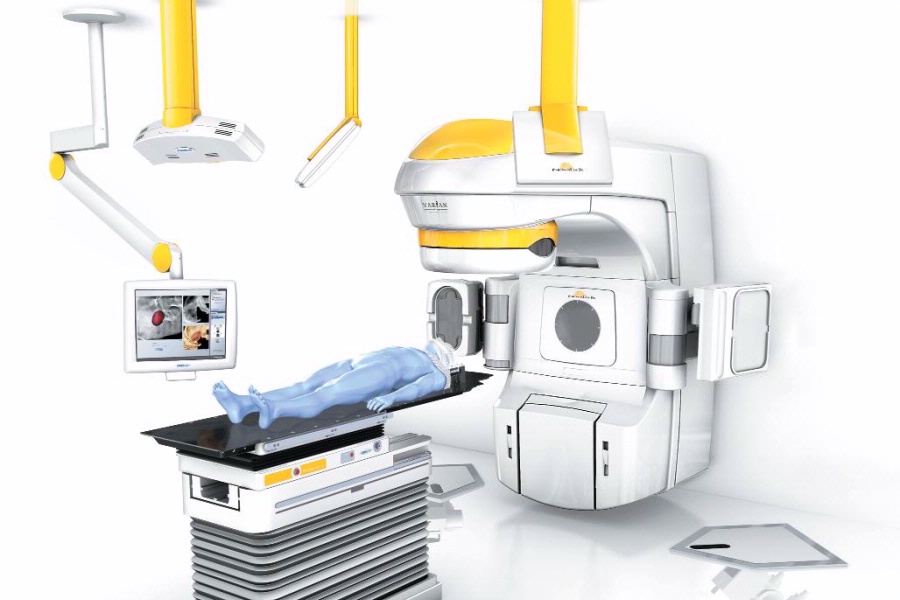
Gamma Knife is a radiosurgery system that treats brain tumours, vascular malformations and trigeminal neuralgia without an incision or general anaesthesia. We explain how the method works, who it suits, how the procedure is done and what side effects are possible.
What Gamma Knife is and how it works
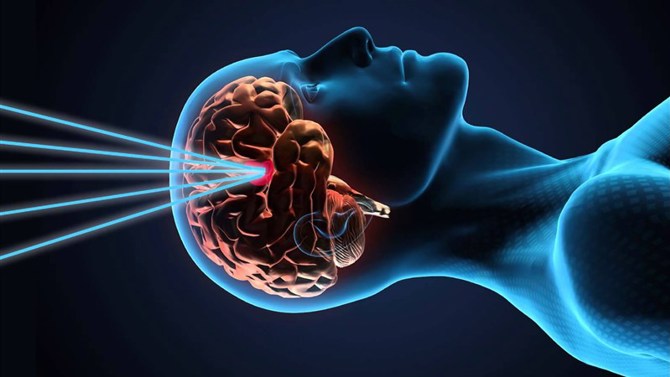
Despite its name, Gamma Knife is not a knife: it is a machine that focuses about 200 thin beams of gamma radiation on a single point with sub-millimetre accuracy. Each beam alone does not harm the tissue it passes through, but where the beams meet the dose is high enough to damage the DNA of tumour cells. They lose the ability to divide, and the tumour stops growing or shrinks over time.
In arteriovenous malformations the radiation makes the abnormal vessels close gradually, and in trigeminal neuralgia it reduces the transmission of pain signals. The effect develops gradually — from a few weeks to two or three years — so the method is not suitable when an immediate result is needed.
Conditions treated with Gamma Knife
- brain metastases;
- meningiomas;
- acoustic neuroma (vestibular schwannoma);
- pituitary adenomas, craniopharyngiomas;
- selected gliomas, mostly small recurrences;
- haemangioblastomas, chordomas, glomus tumours;
- arteriovenous malformations and cavernomas;
- trigeminal neuralgia;
- essential tremor, some forms of epilepsy.
Gamma Knife works best for lesions up to 3–4 cm, when the tumour lies deep or next to critical structures, or when open surgery is undesirable for the patient. It is used in both adults and children. More about the procedure and clinics on the Gamma Knife for brain tumours page.
How the procedure is done
Treatment is planned and delivered by a team: a neurosurgeon, a radiation oncologist and a medical physicist. The procedure is usually outpatient and takes one day.
- Head fixation. A stereotactic frame attached under local anaesthesia or a custom thermoplastic mask is used. The frame gives maximum precision; the mask is more comfortable and allows treatment to be split into several sessions. The head does not need to be shaved.
- Imaging. An MRI, and if needed a CT or angiogram, is performed to define the target precisely.
- Planning. The doctors calculate the dose and beam directions; this takes 30–90 minutes while the patient rests.
- Treatment. The patient lies on a couch that slides into the machine. A session lasts from 15 minutes to a few hours and is painless and silent; staff can see and hear the patient throughout.
- Afterwards. The frame or mask is removed, and after a short observation the patient goes home or to the hotel.
Risks and side effects
Radiosurgery is less invasive than open surgery: there is no incision, bleeding or risk of wound infection. However, the following are possible:
- headache, nausea and tiredness in the first days;
- brain swelling around the treated area — may appear weeks or months later and is treated with medication;
- numbness or weakness of the face, problems with balance, hearing or vision — depending on the target location;
- temporary hair loss over a superficial tumour;
- seizures — rarely.
Radiation treatment is not given during pregnancy, so women of childbearing age may be offered a test before the procedure.
Gamma Knife or CyberKnife
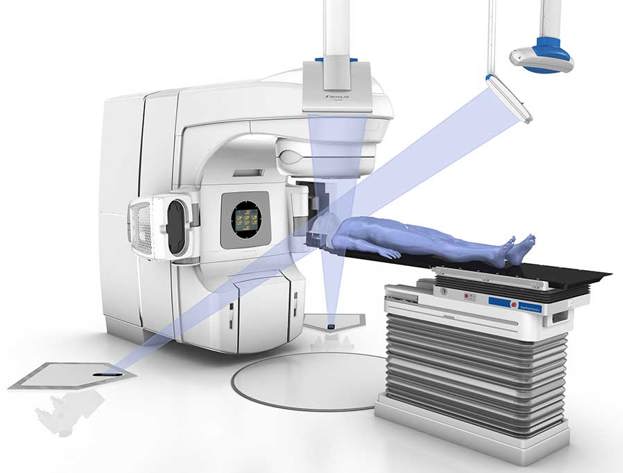
Gamma Knife was designed specifically for the brain and offers the highest precision in this area. CyberKnife is a robotic linear accelerator used for tumours not only of the brain but also of the spine, lungs, liver and prostate. A tumour board decides which machine suits a particular case.
Frequently asked questions
How long do I need to stay in the clinic?
Usually one day: the procedure is outpatient, and the patient returns home or to the hotel in the evening.
When can I get back to normal life?
Most patients resume their usual activities the next day unless the doctor advises otherwise.
How will I know the treatment has worked?
The result is assessed with follow-up MRI — usually at 3, 6 and 12 months, then once a year.
Do I need any special medication?
No. If headache or nausea appears after the procedure, the doctor will prescribe medicines to relieve them.
Want to know whether Gamma Knife is right for you? Send a request with your MRI images — Clinics Direct coordinators will obtain an opinion from neurosurgeons and the cost of treatment in clinics in Turkey, Germany, Spain and Israel, free of charge.
