How quickly does a brain tumour grow? The growth rate of tumours in the brain depends on their histological type, location, the stage of the disease and the individual characteristics of the patient.
Causes of brain tumours
The true causes of tumours of the central nervous system are still poorly understood. The following factors can contribute to their development:
Exposure to ionising radiation.
Disturbances in the formation of the central nervous system before birth.
Constant contact with toxic substances.
Previous head injuries.
Genetic conditions (neurofibromatosis, Turcot syndrome, von Hippel-Lindau syndrome).
What triggers a brain tumour
Like other tumours, tumours of the central nervous system form when cells begin to divide uncontrollably, and the dividing cells may be differentiated to a different degree. The unfavourable factors listed above can start this process.
Risk factors
Risk factors for tumours of the central nervous system include:
Male sex.
HIV infection.
Constant contact with petroleum products, pesticides, arsenic, lead and mercury.
Age under 8 and over 79.
Previous radiotherapy.
Classification of tumours
Brain tumours are divided into several types according to their histological structure.
Astrocytomas. This glial tumour forms from astrocytes. Astrocytomas vary in grade and therefore in how dangerous they are.
Oligodendrogliomas. This tumour forms from oligodendrocytes. It can develop at any age but is more common after 30, mainly in men.
Ependymomas. The tumour forms from ependymal cells that line the ventricles of the brain. It is diagnosed in children as well as in adults and elderly patients.
Mixed gliomas. These tumours have a mixed cell composition, and their behaviour and growth rate are hard to predict.
Pituitary adenomas. A benign tumour that forms from the glandular tissue of the pituitary.
CNS lymphomas. Lymphomas of the central nervous system are among the most aggressive malignant diseases and can develop in any structure of the brain.
Meningiomas. These tumours form from cells of the arachnoid membrane of the brain. In most cases meningiomas are benign.
Symptoms of brain tumours
Focal symptoms of tumours of the central nervous system include:
Memory impairment.
Reduced sensitivity to touch, pain and temperature.
Paralysis and weakness of the limbs.
Reduced vision.
Hearing loss.
Epileptic seizures.
Changes in speech and writing.
Auditory and visual hallucinations.
Cognitive decline.
Loss of coordination.
General symptoms include:
Dizziness.
Vomiting that is not related to food.
Chronic headache, mainly in the morning.
Diagnosis
The following methods are used to detect benign and malignant tumours of the central nervous system:
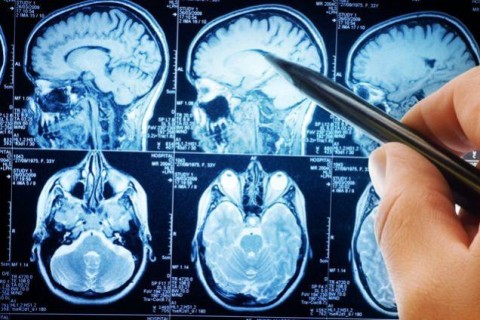
Magnetic resonance imaging.
Computed tomography.
Electroencephalography.
Additional methods include ophthalmoscopy and computerised perimetry.
Treatment
Brain tumours are treated both surgically and without surgery.
Alternatives to surgery: when the tumour is small or cannot be operated on, other methods may be used.
Radiotherapy: external beam radiotherapy is usually given five times a week over several weeks. Brachytherapy and stereotactic radiosurgery, which destroys the tumour with a concentrated beam of ionising radiation, are also used.
Chemotherapy: alkylating agents (carmustine, temozolomide, nimustine, lomustine) and antimetabolites (cytarabine and methotrexate) are used. The drugs may be given as capsules or tablets or intravenously.
Targeted therapy for brain cancer includes anti-angiogenic drugs and cyclin-dependent kinase inhibitors.
Combined radiotherapy and chemotherapy is often used as palliative care for patients with inoperable tumours. This approach can also improve three-year survival in low-grade gliomas.
Cryosurgery: freezing is used for widespread tumours and tumours that are hard to reach, often in elderly patients.
What are the consequences of a brain tumour?
A person with a CNS tumour may face the following consequences:
Depression.
Seizures.
Impaired outflow of cerebrospinal fluid followed by hydrocephalus.
Rehabilitation
Depending on which functions were lost, rehabilitation includes therapeutic massage, exercise therapy and physiotherapy. If hearing is affected, patients work with an audiologist and receive medication that improves the transmission of impulses between neurons.
Brain tumour and life expectancy
The term brain tumour covers a whole group of different conditions located inside the skull, which may be benign or malignant. All of them are based on uncontrolled division of cells of the central nervous system. Symptoms and life expectancy depend directly on the type of tumour and its grade.
Types of brain tumour and prognosis
Malignant tumours differ in their histological structure, growth pattern, growth rate and the way they spread. The prognosis largely depends on the stage at which treatment was started.
Meningioma
This tumour develops from cells of the arachnoid membrane and is usually benign. The prognosis depends on the type of tumour and its histological structure. Tumours without atypical cells generally do not recur after complete removal. Surgery is technically difficult when the tumour is located at the skull base, in the cavernous sinus or at the falcotentorial junction.
For benign meningiomas that were operated on in time, the recurrence rate within five years of surgery is about 3%. For malignant meningiomas it is 38 to 80% within five years. The outlook for benign tumours is relatively favourable and depends on how early treatment was started; it is less favourable for multiple and atypical meningiomas. Life expectancy is also affected by other conditions such as atherosclerosis, diabetes and coronary heart disease.
Astrocytoma
This primary neuroepithelial tumour forms from astrocytes (star-shaped cells) in the brain itself. Astrocytomas differ in grade, and this determines the prognosis: low-grade tumours that are completely removed have a much better outlook than high-grade tumours, which are harder to treat. Only the treating doctor can give a prognosis for a particular patient.
Ependymoma
This tumour forms from the ependymal tissue lining the ventricles of the brain. Ependymomas account for about 8% of all tumours of the central nervous system. Most often the tumour is located in the posterior cranial fossa and grows slowly. Five-year survival when the tumour is found and removed in time is 65-80%. The least favourable prognosis applies to anaplastic ependymomas, because they spread quickly with the cerebrospinal fluid.
Life expectancy at different stages
Each stage of a brain tumour is accompanied by characteristic structural and functional changes in the central nervous system, and these changes directly affect life with the diagnosis.
Stage 1. The tumour does not progress rapidly. If the necessary treatment is given at this stage and the patient responds well, the outlook is relatively favourable: about 70-75% of patients live five years or longer.
Stage 2. Life expectancy depends on the type of tumour, its grade and growth rate. As at stage 1, the tumour does not grow quickly, but it slowly infiltrates nearby healthy areas of the brain. Living longer than five years is possible if the disease does not recur.
Stage 3. The tumour is moderately aggressive and poses a serious threat to health and life. Some tumours at this stage cannot be operated on. Average life expectancy after surgery at stage 3 is one to three years.
Stage 4. The outlook is very poor, because the tumour grows quickly and invades nearby areas of the brain. Average life expectancy at stage 4 is one to two years.
Life expectancy after surgery
Life expectancy after surgery for brain cancer depends directly on the stage at which the operation was performed. The best outlook is at stage 1, provided the disease does not recur afterwards. These are average figures: every case is different, and the stage at which the disease is found affects both the prognosis and the cost of treatment.
Still have questions? Call us or leave a request, and our medical coordinators will tell you about clinics, specialists and treatment prices.