
Stage 4 lung cancer: life expectancy, the symptoms that appear in the final stage and near the end of life, how to ease a loved one's condition, and which treatments extend life today. More on the lung cancer page.
What stage 4 lung cancer means
Stage 4 means the tumour has spread beyond the lung where it started: to the other lung, the pleura or pericardium, or to distant organs such as the bones, liver, adrenal glands or brain. In the TNM classification this is category M1: M1a — spread within the chest, M1b — a single metastasis in another organ, M1c — multiple distant metastases. Lung cancer often grows without symptoms for a long time, so a large share of cases are first found at this stage.
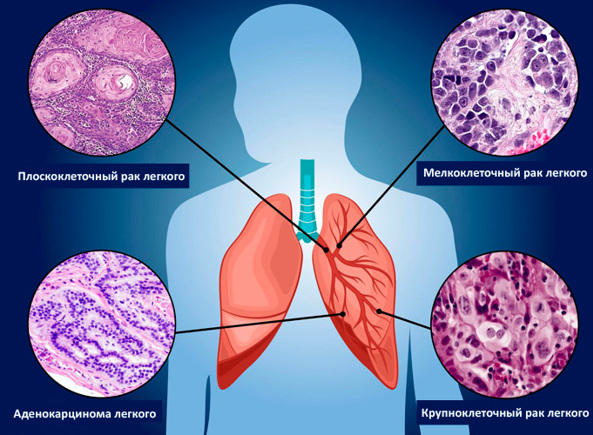
About 85% of cases are non-small cell lung cancer (adenocarcinoma, squamous cell and large cell carcinoma); the rest are small cell lung cancer, which grows faster and spreads earlier.
Life expectancy with stage 4 lung cancer
There is no single figure. According to the US SEER registry, five-year relative survival for non-small cell lung cancer with distant spread is about 8–9%, and about 3% for small cell lung cancer. These numbers describe patients diagnosed several years ago and do not fully reflect today's medicines.
Without treatment, survival is usually measured in months. With treatment the outlook depends on:
- the tumour type and its molecular features — EGFR, ALK, ROS1 or BRAF alterations, PD-L1 level;
- the number and location of metastases;
- general health, age and other conditions;
- response to treatment.
Patients whose tumours carry a targetable mutation, and those who respond well to immunotherapy, often live with the disease for years. That is why molecular testing of the tumour is the first thing to arrange after diagnosis.
Symptoms of stage 4 lung cancer
- a persistent cough, coughing up blood;
- shortness of breath, chest pain, hoarseness;
- fatigue, loss of appetite and weight;
- repeated bronchitis or pneumonia.
Metastases cause symptoms of their own: bone pain and fractures; headaches, dizziness, seizures or speech problems when the brain is affected; jaundice and discomfort under the right ribs when the liver is involved; enlarged lymph nodes above the collarbone.
End-of-life symptoms in stage 4 lung cancer
This section is for relatives who are caring for a seriously ill person and want to understand what is happening. When the disease stops responding to treatment, the condition changes gradually.
In the final weeks
- weakness increases; the person spends most of the day in bed and sleeps a lot;
- appetite disappears, swallowing becomes difficult, weight is lost quickly;
- breathlessness worsens — first on movement, then at rest;
- pain requires stronger painkillers;
- swelling, confusion and restlessness may appear.
In the final days and hours
- the person sleeps almost all the time and is hard to wake, stops eating and drinking;
- breathing becomes irregular, with pauses, sometimes noisy and rattling;
- hands and feet turn cold, the skin becomes pale with bluish mottling;
- little urine is passed; blood pressure and body temperature fall;
- consciousness fades; hallucinations and disorientation are possible.
What people with lung cancer die from
The immediate cause is most often respiratory failure, pneumonia, bleeding, a blood clot in the lungs, or failure of organs affected by metastases, such as the liver or brain.
How to ease the condition
Pain and breathlessness can and should be relieved. Opioid painkillers reduce both pain and the feeling of air hunger; oxygen, a raised head of the bed, fresh air and mouth care also help. Do not force the person to eat. A palliative care team or hospice will choose the medicines and teach the family how to care — it is worth contacting them early, not in the last days.
End-of-life symptoms at stages 1, 2 and 3
At stages 1–3 lung cancer is treated — with surgery, radiotherapy and drug therapy — and a considerable share of patients recover. The signs described above appear only if the disease progresses to stage 4.
Causes and risk factors
- smoking, including second-hand smoke — linked to the majority of cases;
- radon in homes;
- occupational exposure to asbestos, arsenic, chromium, nickel and diesel exhaust;
- air pollution;
- lung cancer in close relatives — in this case genetic testing may be useful.
Diagnosis
- contrast-enhanced CT of the chest and abdomen;
- PET-CT to look for distant metastases;
- MRI of the brain;
- bronchoscopy or CT-guided transthoracic biopsy;
- histology and immunohistochemistry, PD-L1 testing;
- molecular testing for EGFR, ALK, ROS1, BRAF, KRAS, MET and RET alterations — on tumour tissue or blood (liquid biopsy).
Treatment of stage 4 lung cancer
At stage 4 the goal is to control the disease, extend life and preserve its quality. Clinics in Germany, Israel, Turkey, Spain and South Korea use:
- targeted therapy — tablets that act on a specific tumour mutation;
- immunotherapy with checkpoint inhibitors — alone or combined with chemotherapy;
- chemotherapy — the backbone of treatment for small cell and some non-small cell tumours;
- radiotherapy, including stereotactic radiosurgery for isolated metastases in the brain, bones or adrenal glands;
- surgical and endoscopic procedures when indicated — for example to drain fluid from the pleura or reopen a blocked airway.
The plan is chosen by a multidisciplinary tumour board. When standard options are exhausted, the doctor may suggest a clinical trial. Palliative care — pain relief, oxygen support, nutrition and psychological support — starts alongside anti-cancer treatment, not instead of it.
Frequently asked questions
Can stage 4 lung cancer be cured?
A complete cure is rare, but modern therapy can stop tumour growth for a long time. In some patients the disease stays under control for years.
How long can you live with stage 4 lung cancer without treatment?
Usually a few months. Even at this stage treatment extends life and eases symptoms, so it should not be refused.
Is surgery performed at stage 4?
Usually not. The exception is selected cases with one or two metastases, when all lesions can be removed or irradiated after systemic therapy.
Is a second opinion abroad worthwhile?
Yes: a pathology review and extended molecular testing sometimes reveal treatment options that were not considered before. See clinics in oncology and pulmonology.
Still have questions? Send a request — Clinics Direct medical coordinators will help you choose a clinic and specialist and find out the cost of treatment, free of charge.
