
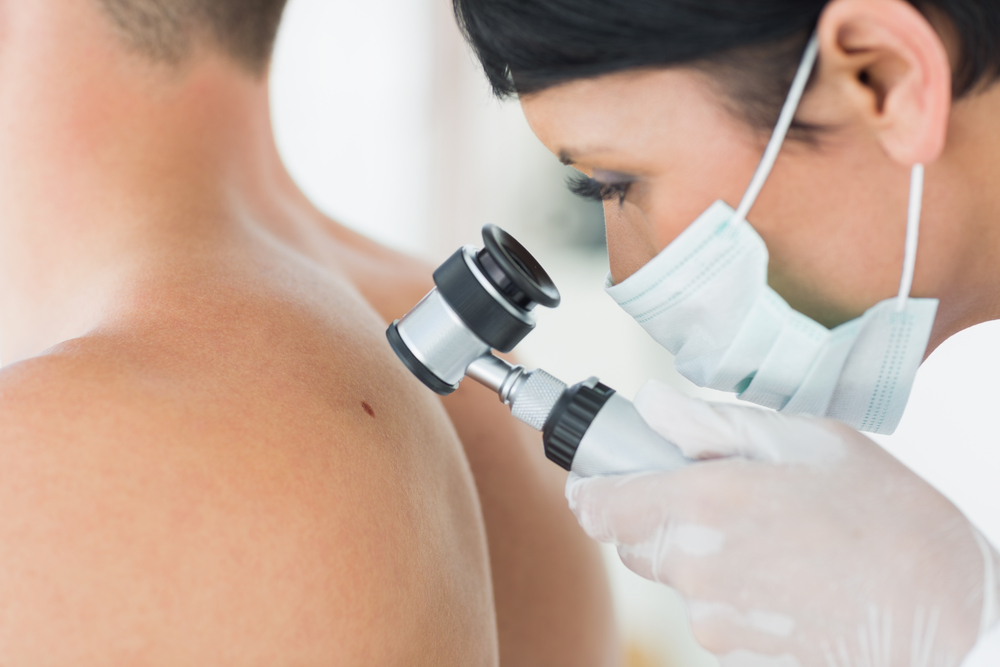
Melanoma is the most dangerous type of skin cancer, yet at an early stage it is cured with a small operation. We explain how to recognise a dangerous mole, which tests are needed, and how melanoma is treated in clinics in Germany, Israel and Turkey.
What is melanoma
Melanoma develops from melanocytes — the cells that produce the pigment melanin. It most often arises on the skin, less often in the eye or on mucous membranes. Melanoma accounts for only a few percent of all skin cancers, yet it causes most skin cancer deaths because it can spread early — to lymph nodes, lungs, liver, bones and brain. Other skin cancers — basal cell and squamous cell carcinoma — grow more slowly and are mostly cured by surgery.
Melanoma occurs at any age and is among the most common tumours in young adults. The main risk factors are sunburn and sunbeds, fair skin, a large number of moles, and melanoma in close relatives.
Signs of melanoma: the ABCDE rule
- A (asymmetry) — the two halves of the mole do not match;
- B (border) — irregular, blurred edges;
- C (colour) — uneven colour, several shades;
- D (diameter) — larger than 6 mm;
- E (evolution) — any change: the mole grows, changes shape or colour, itches or bleeds.
Another clue is the “ugly duckling”: a lesion that looks clearly different from the other moles. If you notice any of these signs, see a dermatologist.
Diagnosis of melanoma
- Dermoscopy and digital mole mapping — help to notice changes at the earliest stage.
- Excisional biopsy — the suspicious lesion is removed completely and examined. Histology determines the Breslow thickness — the key prognostic factor.
- Sentinel lymph node biopsy — checks whether tumour cells have spread.
- PET-CT and brain MRI — when metastases are suspected.
- Molecular testing for the BRAF mutation — the result guides the choice of drugs.
- Pathology review — if the mole has already been removed, the clinic abroad re-examines the slides and blocks.
Treatment of melanoma
Early stages
The main treatment is wide excision of the tumour with a 1–2 cm margin of healthy skin. If the melanoma is thin and the lymph nodes are clear, treatment ends there and the patient only has regular check-ups.
Lymph node involvement
After surgery, adjuvant therapy is given for a year — immunotherapy with PD-1 inhibitors or, if a BRAF mutation is present, targeted drugs. This lowers the risk of the disease returning.
Metastatic melanoma
Treatment has changed radically over the past decade. Immunotherapy (PD-1 inhibitors alone or in combination) and targeted therapy with BRAF and MEK inhibitors allow a considerable share of patients to live for years. Isolated metastases, including those in the brain, are treated with radiosurgery or removed. Some centres offer cell therapy with tumour-infiltrating lymphocytes (TIL) and access to clinical trials.
Prognosis
According to the SEER registry, five-year relative survival for localised melanoma is above 98%. With distant metastases it is much lower — about a third of patients — although it has risen noticeably since immunotherapy became available. The key is not to delay seeing a doctor and to remove the tumour while it is thin.
Why melanoma is treated abroad
- digital dermoscopy with mapping of all moles and follow-up over time;
- pathology review by pathologists who specialise in skin tumours;
- sentinel node biopsy and tissue-sparing surgery with a good cosmetic result;
- access to modern immunotherapy, targeted therapy and clinical trials;
- decisions made by a multidisciplinary tumour board.
The cost depends on the stage and the scope of tests: a consultation with dermoscopy and removal of a lesion costs many times less than a work-up with PET-CT and sentinel node biopsy. The clinic prepares an exact plan with prices after reviewing the records. See clinics in the oncology section.
Frequently asked questions
Is every dark mole dangerous?
No. What matters is not the colour but change and the ABCDE signs.
Can moles be removed by laser?
Suspicious lesions — no: laser leaves no tissue for histology. They are excised with a scalpel.
How can the risk of melanoma be reduced?
Avoid sunburn and sunbeds, use sunscreen, and have your moles checked by a dermatologist once a year, especially if you have many.
Noticed suspicious skin changes or already diagnosed with melanoma? Do not lose time — send a request, and Clinics Direct coordinators will help you choose a clinic and obtain a diagnostic and treatment plan with prices, free of charge.
