
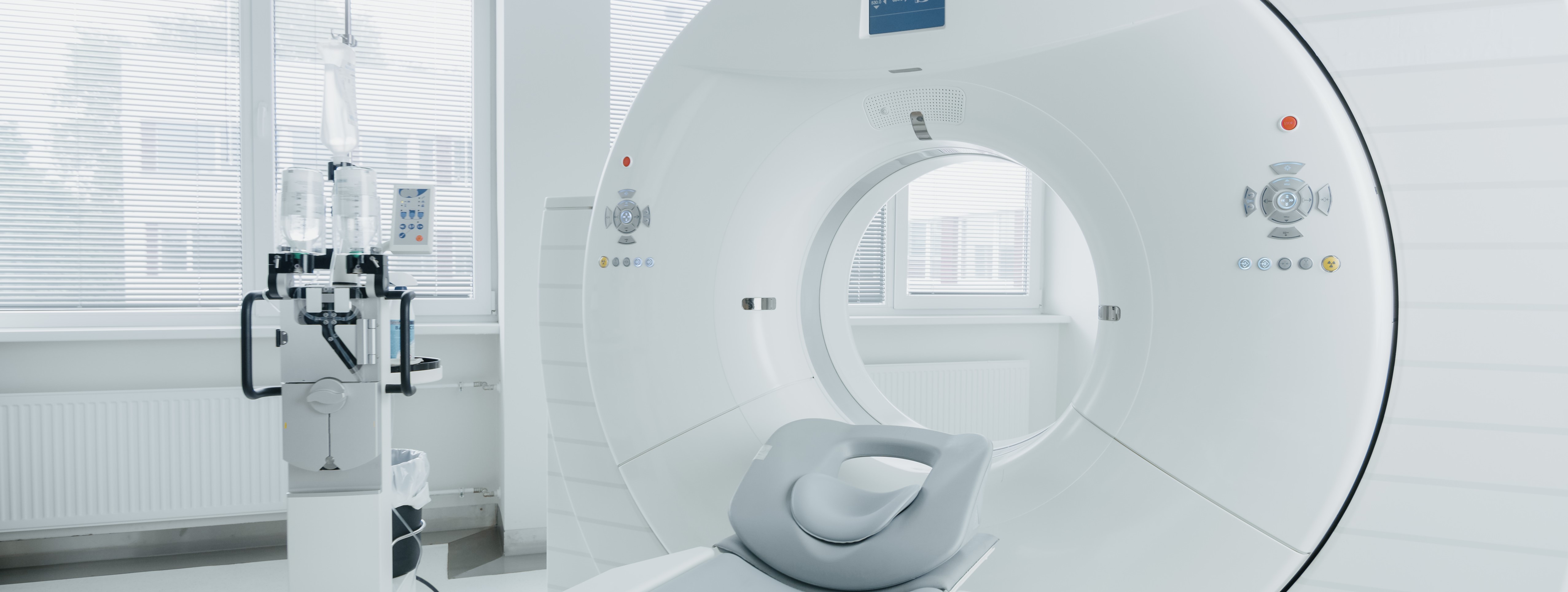

What is PET-CT?
PET-CT is a hybrid imaging method. It combines:
- positron emission tomography (PET);
- computed tomography (CT).
PET is a nuclear medicine technique that shows the level of metabolism in different parts of the body. To do this, small amounts of radioactive substances, called radiotracers or radiopharmaceuticals, are introduced into the patient's body. They accumulate in tumours and areas of inflammation, or bind to certain proteins in the body. PET makes it possible to see how intensely the radiotracer accumulates and to diagnose a disease at an early stage.
CT is a method of obtaining cross-sectional images (slices) of the bones, blood vessels and soft tissues of the body. During a CT scan, a series of X-ray images taken from different angles is combined by computer processing. The result is a detailed layer-by-layer image of organs and tissues that shows the location of a tumour and its borders.
By combining PET with CT, the doctor can obtain detailed information about changes in structure and metabolism at the cellular level. As a result, after a PET-CT scan the patient receives the right treatment sooner, which increases the chances of recovery.
When is PET-CT used?
PET-CT is never prescribed to completely healthy people. Most often the scan is needed when cancer has already been diagnosed. In oncology, PET-CT makes it possible to:
- determine the stage of the cancer (how far the malignant process has spread in the body);
- choose the most suitable treatment;
- assess the response to treatment, for example the effectiveness of chemotherapy or radiotherapy;
- detect a recurrence of cancer before symptoms appear.
PET-CT is not used only for cancer. The method allows a very precise assessment of the structure and function of the brain and heart, which helps to:
- assess the metabolism and viability of tissues;
- determine the consequences of a previous heart attack;
- predict the possible benefit of angioplasty or coronary bypass surgery;
- detect and study brain abnormalities, such as tumours, memory disorders, seizures and other diseases of the central nervous system.
Contraindications and risks of PET-CT
PET-CT is a painless and safe diagnostic method. Rare adverse effects are nevertheless possible, related to:
- a reaction or allergy to the radiopharmaceutical;
- being inside the closed tunnel of the scanner, which can be unpleasant for people with claustrophobia.
To make the procedure as comfortable as possible, in some medical centres, for example at the Medipol clinic in Turkey, PET-CT scanners can create a sky-like setting.
Because of the possible negative effect of X-rays and the radiotracer on the foetus, PET-CT is not advisable during pregnancy. This contraindication is not absolute, however, so in rare situations PET-CT is performed on pregnant women as well. Analysis of such cases has not revealed a harmful effect on the foetus.
Myths about PET-CT
A lot of inaccurate information about PET-CT can be found on the internet and on patient forums. Often these are the conclusions of people with no medical background, which are not supported by research.
PET-CT is a waste of money; an ordinary CT or MRI is enough
A number of clinical studies have compared PET-CT with other imaging methods. They found that in a third of patients PET/CT reveals changes that were not found on PET or CT alone. This makes it possible to choose the right treatment straight away and to improve the chance of recovery.
For example, in one real patient with lung cancer, PET/CT revealed not only the primary tumour in the lung, which had been found earlier on CT, but also an additional tumour that was not visible on CT.
If the doctor had relied on the CT results alone, he would have recommended surgery. The additional tumour found by PET/CT showed that the cancer had spread and was inoperable. Based on this information, the doctor started radiotherapy, which gave the patient a better chance of survival.
The radiation dose of PET-CT is high and can make cancer progress
The world around us constantly emits radiation. For example, people living in the USA receive an annual dose of background radiation of about 3 millisieverts (mSv). In Ramsar, Iran, annual background exposure is many times higher and reaches 260 mSv. Background radiation comes from many sources, including:
- cosmic radiation;
- environmental radioactivity from natural radioactive materials such as radon and radium;
- radiation resulting from nuclear weapons tests and radiation accidents.
Yet not everyone around us develops cancer. The human body has repair mechanisms to deal with the damage caused by low doses of radiation. The average radiation dose of a PET-CT scan is only 25 mSv, which the body can cope with.
I will give off radiation for many days after the procedure
Some people think that the radioactive isotope stays in the body for a long time. In fact, 12 hours after PET-CT the emitted dose is so low that it is safe to breastfeed a child. A day after the procedure no radiotracer remains in your body.
How to prepare for PET-CT
For the PET-CT results to be as accurate as possible, a few simple rules should be followed.
- Avoid intense physical activity for 24 hours before the scan.
- Have your last meal no later than 4–6 hours before the procedure.
- Drink enough fluids to avoid dehydration.
- Do not chew gum or suck any sweets or lozenges, including cough drops.
- Rings, earrings and other jewellery will have to be removed before the scan, so it is better to leave them at home.
- It is advisable to wear comfortable, loose clothing, although you will be given a disposable medical gown before the procedure.
The radiopharmaceuticals used in PET-CT contain glucose, so patients with diabetes need more careful preparation. Sometimes glucose-lowering medication has to be stopped a few days before the scan. If you use insulin, the last dose should be taken no later than 4 hours before the procedure.
Be sure to tell your doctor if you:
- have chronic diseases;
- take any medication, including vitamins and herbal preparations;
- are pregnant or think you may be;
- have ever had an allergy.
What to expect during PET-CT
The scan consists of two stages: uptake and scanning.
I – The uptake stage
During the uptake stage the patient is given the radiotracer, usually intravenously, and waits until it is distributed through the body. While the tracer is being given and for 45–60 minutes afterwards, the patient:
- needs to sit or lie still;
- must not talk or chew, to avoid increased accumulation of the radiopharmaceutical in the muscles of the larynx and neck, which would distort the PET-CT results;
- should stay warm.
The last point is not only for the patient's comfort. It is important not to get cold during the procedure, because this can cause the tracer to accumulate in fatty tissue. Ideally, the patient should be covered 30–60 minutes before the radiotracer is given and kept warm throughout the PET-CT.
II – The scanning and imaging stage
- The patient is placed in a special PET-CT scanner.
- X-rays are passed through thin layers of the body in different directions.
- Electronic X-ray detectors record the radiation from different parts of the body and transmit it to a computer.
- At the same time, special gamma-ray sensors record the radiation from the radiotracer given intravenously.
- The resulting image of metabolic activity is superimposed on the layer-by-layer image of the body.
As a result, the doctor receives high-resolution information about the structure and metabolism of different organs. The scan itself takes about 30 minutes.
What to do after PET-CT
PET-CT is an outpatient procedure. You do not need to be admitted to hospital for it. You can leave the clinic as soon as the scan is finished.
For some time after the scan a person gives off a small dose of radiation. To protect yourself and others, for 12 hours after the procedure you should:
- Limit close contact with small children and pregnant women.
- Refrain from breastfeeding. For 12 hours the milk should simply be expressed, after which you can return to your usual feeding routine.
To help the radiotracer leave your body faster, drink plenty of fluids. You can return to your usual diet straight after the scan.
Why travel abroad for PET-CT?
PET-CT is the gold standard for diagnosing most malignant diseases. At the same time, in many countries the method remains hard to access. As a result, not many local specialists have experience in interpreting the results, and many patients do not get the scan because of waiting lists.
The advantages of having PET-CT abroad are:
- modern equipment;
- no waiting lists lasting many months;
- the procedure is performed and interpreted by doctors with 30 years of experience in nuclear medicine.
Where can you have PET-CT abroad?
PET-CT is successfully performed for international patients in clinics in Turkey, Germany, Spain and Israel. When choosing a clinic, many factors should be considered, including:
- the diagnosis;
- other medical conditions;
- the patient's wishes.
Leave a request and our coordinating doctors will select the most suitable centre for you free of charge, taking into account your wishes and the specifics of your condition.
What scanners are used for PET-CT abroad?
Although PET-CT is already an innovative diagnostic method, clinics abroad perform it on the most modern scanners. For example, Medipol hospital (Turkey) uses the premium-class Philips Gemini TF scanner for PET-CT. Its main advantages are:
- a lower radiation dose;
- lower doses of the radiopharmaceutical, which reduces the cost of the scan;
- a shorter examination time;
- higher image accuracy;
- the ability to examine larger patients;
- an open design that offers more comfort for anxious patients and patients with claustrophobia.
How much does PET-CT cost abroad?
The cost of PET-CT abroad starts from $650, but it varies widely and depends on many factors. The price is affected by:
- the condition for which the scan is performed;
- the type of radiopharmaceutical;
- the country and the clinic.
For example, the price of PET-CT with gallium, which is the gold standard for diagnosing prostate cancer, starts from $2,000. Leave a request using the form on this page to receive a detailed consultation from our coordinating doctors and to find out the current cost of PET-CT at each clinic.
